By Jrayanna Voyageur, FRAMS Indigenous Student Museum Intern
Tânsi, hello! My name is Jrayanna Voyageur and I am a member of the Athabasca Chipewyan First Nation, raised in Edmonton. I am both Cree and Dene from Alberta, and I am a proud mother to my three-year-old son, Malakai. I am completing my final year at the University of Alberta in the Bachelor of Arts in Native Studies and a Bachelor of Education combined degree program. I applied for the Friends of the Royal Alberta Museum Society (FRAMS) Indigenous Student Museum Internship (ISMI) because I wanted to utilize what I have learned through Native Studies and Education outside of the classroom setting. Surprisingly, before starting my internship I had never stepped foot inside the Royal Alberta Museum (RAM)! Now that my time as one of the three ISMI interns has come to an end, I am so glad that I did.
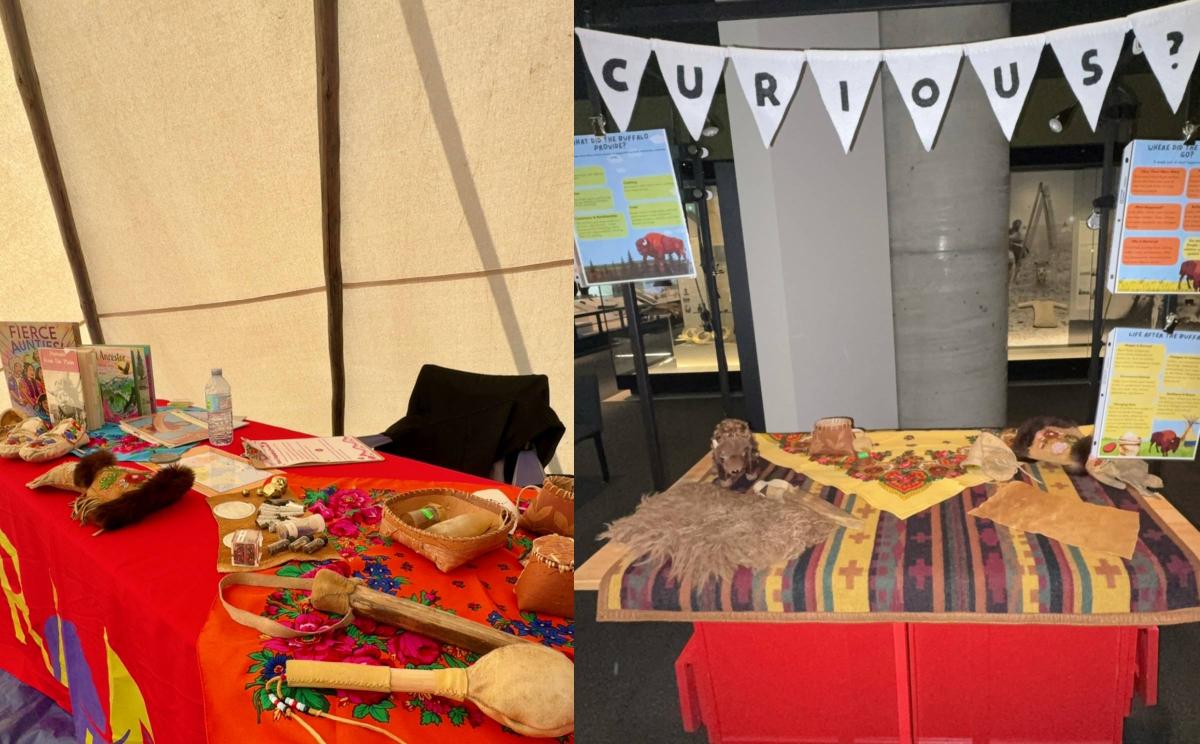
During my time with the Learning team, I created the “What’s in Your Bundle?” drop-in program for RAM’s visit to kihcihkaw askî (Sacred Land) in celebration of National Indigenous Peoples Day. I had the privilege of hosting our program in a tipi, sharing resources about bundle teachings, and connecting with the community! At first, I was a little nervous because I was unsure how the program would play out. Who would stop by? What would visitors think? As soon as the first visitor stopped by, that nervousness quickly turned into confidence and pride in the hard work I put into creating the bundle program. I designed the bundle program as a way to celebrate the different teachings and stories that Indigenous people carry and pass down through generations. A physical bundle can include items that bring you comfort, support your livelihood, and help you feel connected to spirit, culture, and family. For the internal bundle, I created a medicine wheel template to help visitors reflect on their spiritual, mental, emotional, and physical health, and what they may be needing in that moment.
In my time with the Learning team, I also created a drop-in program about the history of the Plains Bison in Alberta. I presented gauntlets, moccasins, and hide-scraping tools to demonstrate how Indigenous people utilized different parts of the bison. Including handling objects as part of the program showed me how much kids enjoy hands-on learning. Being able to touch and interact with the objects helped them connect more with what I was teaching about the bison. The kids really enjoyed feeling the bison fur, and a lot of them were curious about the gauntlet and wanted to know what it was. Some of the kids had never seen anything like this before and thought it was beautiful, which made me feel proud!
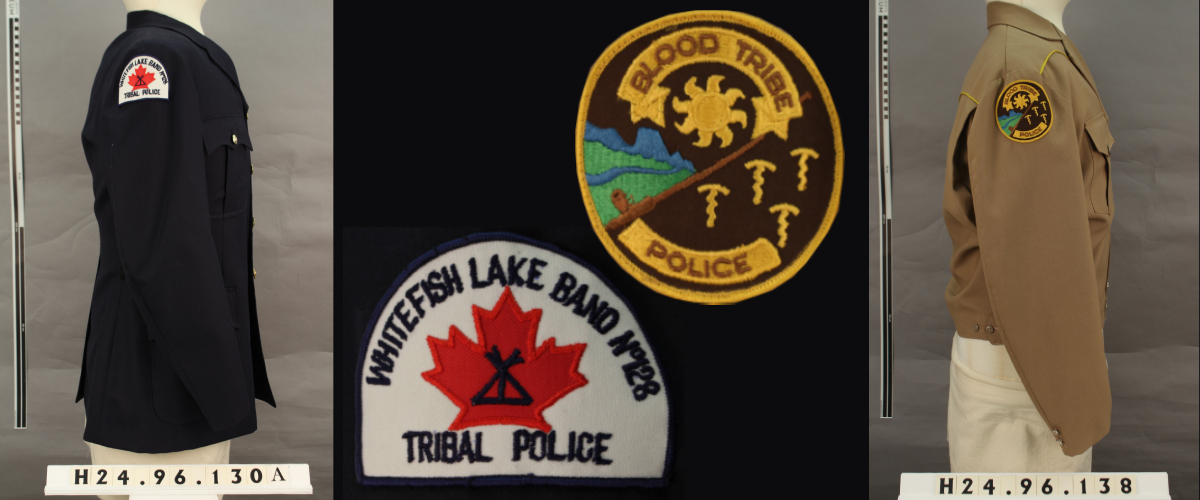
After working in the Learning department, I moved behind the scenes to work with the Military and Government History team. I received training on the museum’s collections management database, and learned how to catalogue pieces by recording their descriptions, conditions, measurements and identifying markings. I also learned museum photography, photo editing and how to carefully sew identification labels onto the uniforms. This work allowed me to use the research skills I developed in university while learning entirely new technical skills! Before this internship, I did not realize how much time and care goes into preserving a single object and making sure its history remains connected to it.
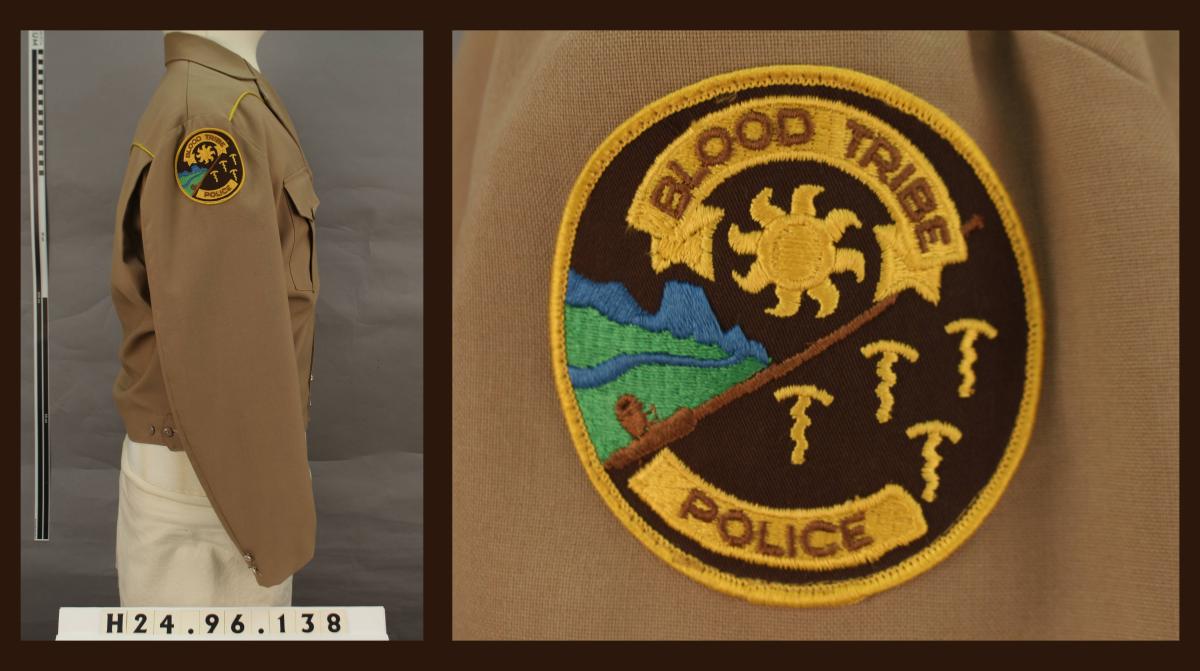
I was given the opportunity to work on a collection of tribal police jackets from Indigenous Nations across Alberta. Most reserves in Alberta are policed by the RCMP, but three Nations are still policed by their own independent police forces, one of them being the Blood Tribe in Treaty 7 territory. I had the opportunity to work on an old Blood Tribe Police Service uniform, which was in excellent condition! I enjoyed looking closely at the patches and seeing how they represented the Nations that the uniforms came from. The Blood Tribe Police patch especially stood out to me because of the history and meaning represented within it. The sun, river, and grass connect to the history of Treaty 7, and the peace pipe represents the Treaty and the Blood Tribe Police Service’s role as the traditional peacekeepers. The mountain represents the land, and the T markings around the patch connect back to the Tribal Scouts, who were the original peacekeepers within the Blood Tribe. Before the modern Blood Tribe Police Service, the Nation had its own laws and an enforcement society called Iikunuhkahtsi. Later, the Tribal Scout system continued this role and eventually developed into the Blood Tribe’s Police Service that exists today.¹ As I learned about the history of the Blood Tribe Police Service, I reflected on the importance of Indigenous-led policing. Their community-based approach focuses on relationship-building through connections with Elders, youth, schools, and community events. It is remarkable that the Blood Tribe continues to hold its own Nation-led police jurisdiction.
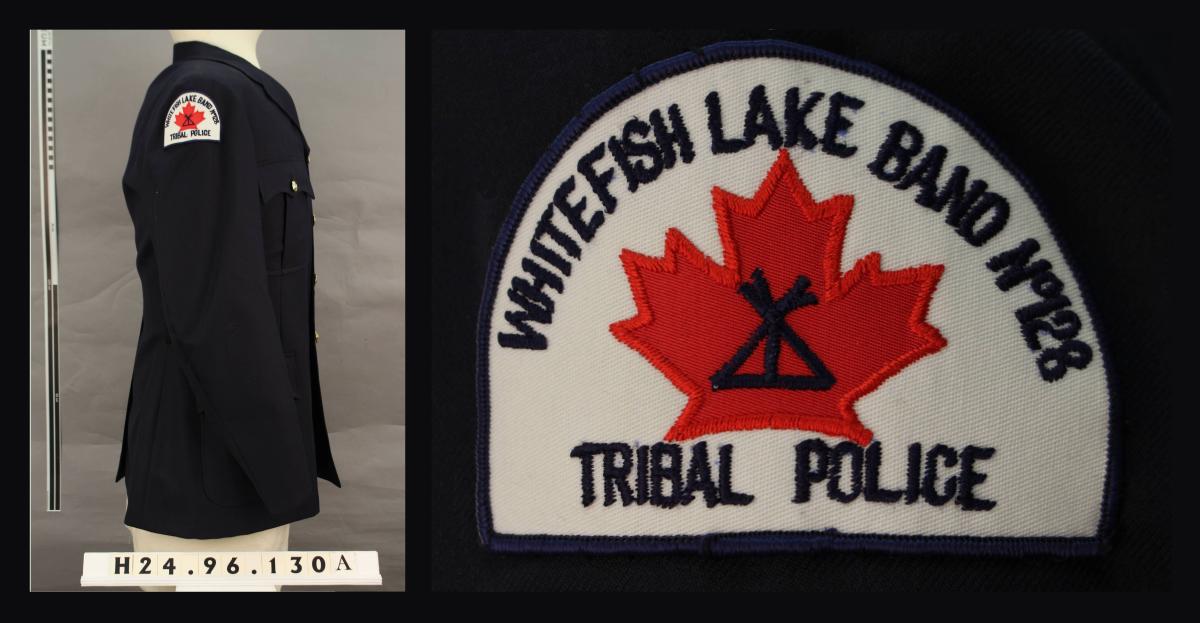
This project instantly became personal to me and my family as I worked on a tribal police uniform from the Whitefish Lake First Nation #128 (Goodfish Lake). Part of my family is from Goodfish which made me super proud! Ever since I found the jacket in the collection, I have been asking my family about what policing looked like back then when the Nation had their own police jurisdiction. When I asked my mom about it, she remembered having tribal police in Goodfish when she was 12 or 13. She remembers the RCMP coming into the community after the tribal police service ended. When I looked further into the history of tribal policing in Whitefish Lake #128, I could not find a clear record explaining exactly when or why tribal police services ended. More broadly, First Nations police services have faced challenges with funding, staffing and long-term sustainability, although I could not confirm that these were specific reasons Whitefish Lake’s service ended. Today, the community is still policed by the RCMP.² That gap in the written history made me even more curious about what happened to Nation-led policing in the community and the stories that are still carried by people who remember it.
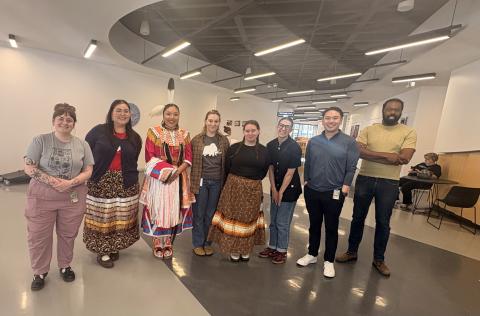
Teaching and learning both happen inside and outside of the classroom. For me, teaching began inside RAM's in Human History Hall at my drop-in program cart, patiently waiting for visitors to drop in. This internship gave me the opportunity to practice my public speaking, relationship-building, professionalism, and teaching while sharing teachings and knowledge that I learned from my family, Elders, and Knowledge Keepers. I am so grateful for the opportunity to be a part of the FRAMS Indigenous Student Museum Internship program; these experiences will be a part of my journey for the rest of my teaching career. As I move into my teaching practicum this coming fall and the beginning of my career as an Indigenous educator, I will carry these experiences with me and continue creating learning spaces where Indigenous youth can see their identities, histories and knowledge represented with pride. Hiy hiy, marci cho, thank you!
Jrayanna Voyageur
References
- Blood Tribe Police Service. “About Us.” Accessed August 10, 2026. https://www.bloodtribepolice.com/about-us
- Lithopoulos, Savvas. Lifecycle of First Nation Administered Police Services in Canada. Ottawa: Public Safety Canada, 2016. https://www.publicsafety.gc.ca/cnt/rsrcs/pblctns/2016-r030/index-en.aspx.