By Camilla Leurini, Live Animals Assistant
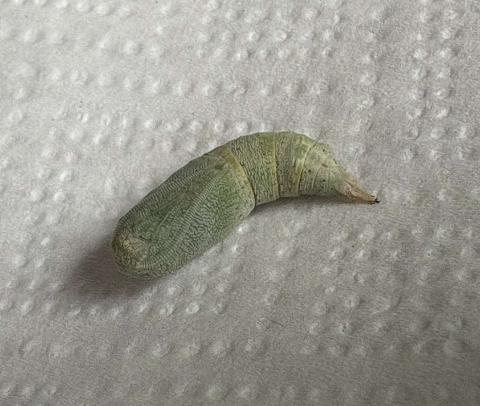
On August 4, the Royal Alberta Museum’s Marketing and Communications department sent the Live Animal Team a message they received on Facebook from Sarah Stadnyk. Attached was a photo of a rather unusual-looking pupa. “I found this strange pupa in my backyard. It’s alive and I really want it to stay that way. Someone in an entomology group identified it as a species native to Europe… so I’m not really sure how it ended up in my patio cushion storage bin. Is there any chance you take in orphaned pupae?! Here is a photo and video for your reference. Even if someone has advice on how to properly care for this guy, I’d appreciate it!”
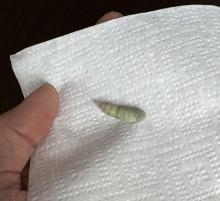
I was immediately curious. And, if I’m being completely honest, a little ignorant about what kind of pupa I was looking at. So, I did what any curious person would do: I forwarded the photo to Dr. Matthias Buck, Assistant Curator of Invertebrate Zoology at the museum. Matthias confirmed that we were looking at a moth pupa. But there was one small problem: we wouldn’t know exactly which moth it was until the adult emerged. That made the response rather easy: “Yes, we’d be happy to take it in. When it emerges, we can let you know what it is.”
Simple enough.
Except… this was no ordinary pupa.
Both Matthias and I are members of the Alberta Lepidopterists’ Guild, a community of people who share a fascination with butterflies and moths. Not long after I contacted Matthias, he walked over to my desk. “The pupa is famous,” he told me. It turned out that Sarah had also reached out to Felix Sperling, a professor at the University of Alberta and fellow member of the Alberta Lepidopterists’ Guild. Felix had shared the photo with the guild and suddenly, everyone was talking about this mysterious pupa.
While life in Edmonton carried on as usual, a small entomological celebrity was making its way toward the museum. And I was very excited.
On August 5, after a bit of coordinating, Sarah and her lovely family arrived at the Royal Alberta Museum bringing the pupa. Together, we found its new home in the museum’s hatchery. After a hatchery tour, they were on their way again (arguably even more excited than when they arrived).
For me, this was one of those wonderful reminders of why museums matter. Sarah and her family had so many stories to share, and you could feel how meaningful the visit was to them. There was something heartwarming about meeting people who are curious about the natural world and being able to share that curiosity with them. They had found something in their backyard that they didn’t understand, but instead of simply throwing it away or ignoring it, they wanted to know what it was. Most importantly, they wanted to keep it alive.
That little pupa had brought all of us together.
Now we just had to wait.
I decided to put a GoPro on the pupa. My plan was simple: record everything and create a time-lapse of the moth emerging. I imagined the moment the adult finally appeared, and people falling in love with this tiny, mysterious creature. There was only one problem. We had absolutely no idea when the moth was going to emerge. After talking with Matthias, we made a plan. If the moth hadn’t emerged by the end of September, I would move it into my garage so it could have the conditions it needed to rest through the winter. In that case, there would be no GoPro.
But we didn’t have to wait that long.
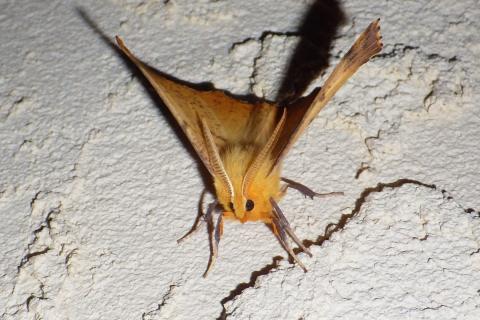
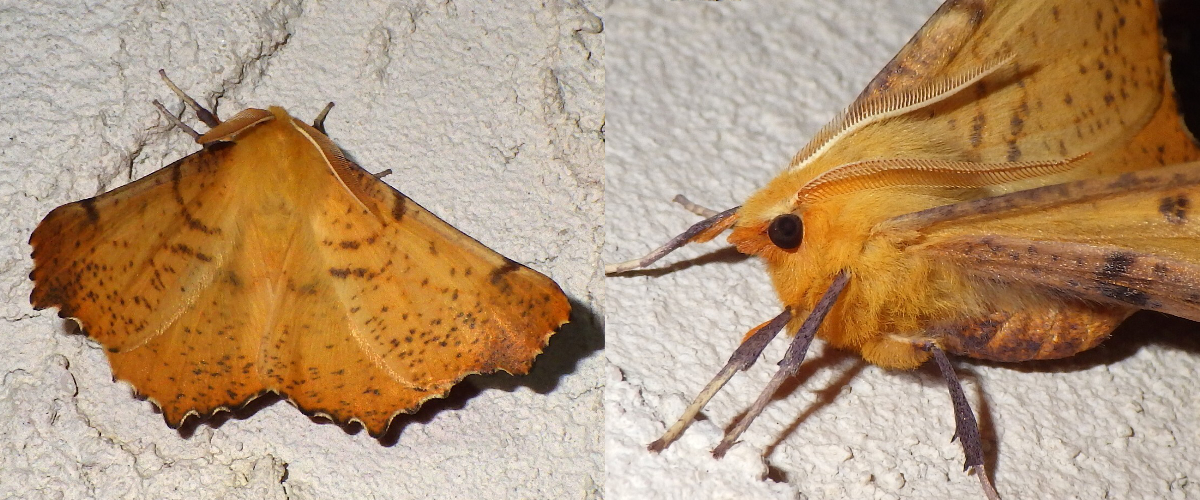
On August 17, just 12 days after arriving at the museum, the pupa finally gave us our answer. The moth emerged. And it was beautiful. After all those weeks of wondering what was inside that mysterious pupa, we finally had our answer: a Maple Spanworm Moth.
Naturally, I couldn’t wait to see the footage. I was already imagining the time-lapse. The emergence. The transformation. The grand finale.
And then… Oopsie doodle. I had put the GoPro on the wrong settings. I am an invertebrate breeder, not a GoPro expert, after all. There was no video. So much for my masterpiece. Fortunately, the moth didn’t need a time-lapse to make its debut memorable. We had something even more important: an identification.
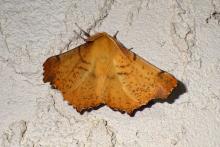
Our mysterious pupa had turned out to be a Maple Spanworm Moth—a little piece of natural history that travelled from a backyard in Edmonton to the Royal Alberta Museum, bringing together a curious family, museum staff, and a whole community of lepidopterists along the way. And perhaps that’s the best part of the story. A strange little pupa found in a patio cushion storage bin became the reason a family walked through the doors of the museum, a group of entomologists started talking, and museum staff spent several days eagerly checking on a tiny creature.
We didn’t get the time-lapse. But we got the moth. And sometimes, that’s more than enough.